The hardest part of document review is not reading. It is knowing which document to read.
That distinction sounds obvious until you watch a junior lawyer spend forty minutes carefully annotating a contract that has nothing to do with the problem — while the clause that matters sits three files away, unchecked. What was missing was not diligence. It was triage.
Document analysis exercises are one of the most transferable formats in legal training. The same underlying structure — a set of documents, a specific question, a decision to make — works for due diligence, disclosure review, regulatory compliance, contract negotiation and a dozen other contexts. Built well, a single exercise can be reused across cohorts, adapted for different practice areas, and scaled without significant additional authoring time. Here is how we build them on BeSavvy.
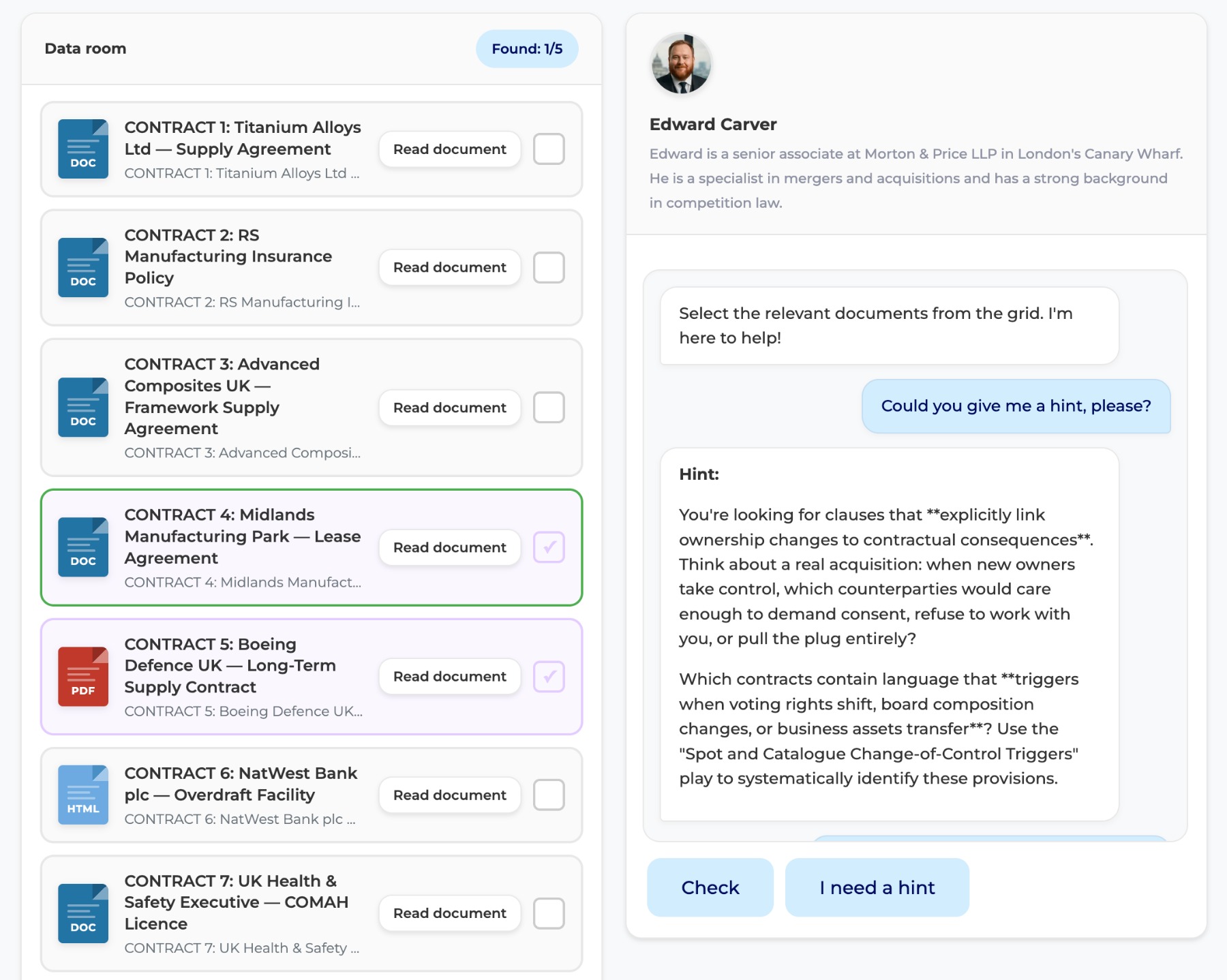
Stage one: the triage task
The first stage places the student in front of a set of documents and asks one well-defined question: which of these is relevant to the problem?
The documents do not need to be complete. Two or three pages per contract is enough — long enough to require genuine reading, short enough to keep the exercise focused. What matters is that each extract contains enough real drafting for the student to engage with it as they would the genuine article, and that the full set includes both relevant and irrelevant documents. The noise is part of the exercise. Knowing which files to ignore is as important as knowing which ones to open.
For the change of control exercise we built recently, the question was: which of these twelve contracts contains a provision that could block completion? The answer required reading across all twelve, recognising what a change of control clause looks like in varied drafting contexts, and prioritising the highest-risk ones for escalation.
An AI mentor sits alongside throughout to discuss the student's reasoning. Why this contract rather than that one? What does the consequence of this particular trigger mean for the deal timeline? The conversation is where the judgement is built.
Stage two: the deep analysis task
Once the student has identified the relevant documents, the exercise can go a level deeper. A single document is brought into focus — and within it, problems are embedded.
These might be drafting errors, missing definitions, conflicting provisions or commercially unreasonable terms. The student reads through, identifies the zones of concern, and either proposes a solution or works through one with the AI mentor. The interaction is direct: find the problem, discuss the fix.
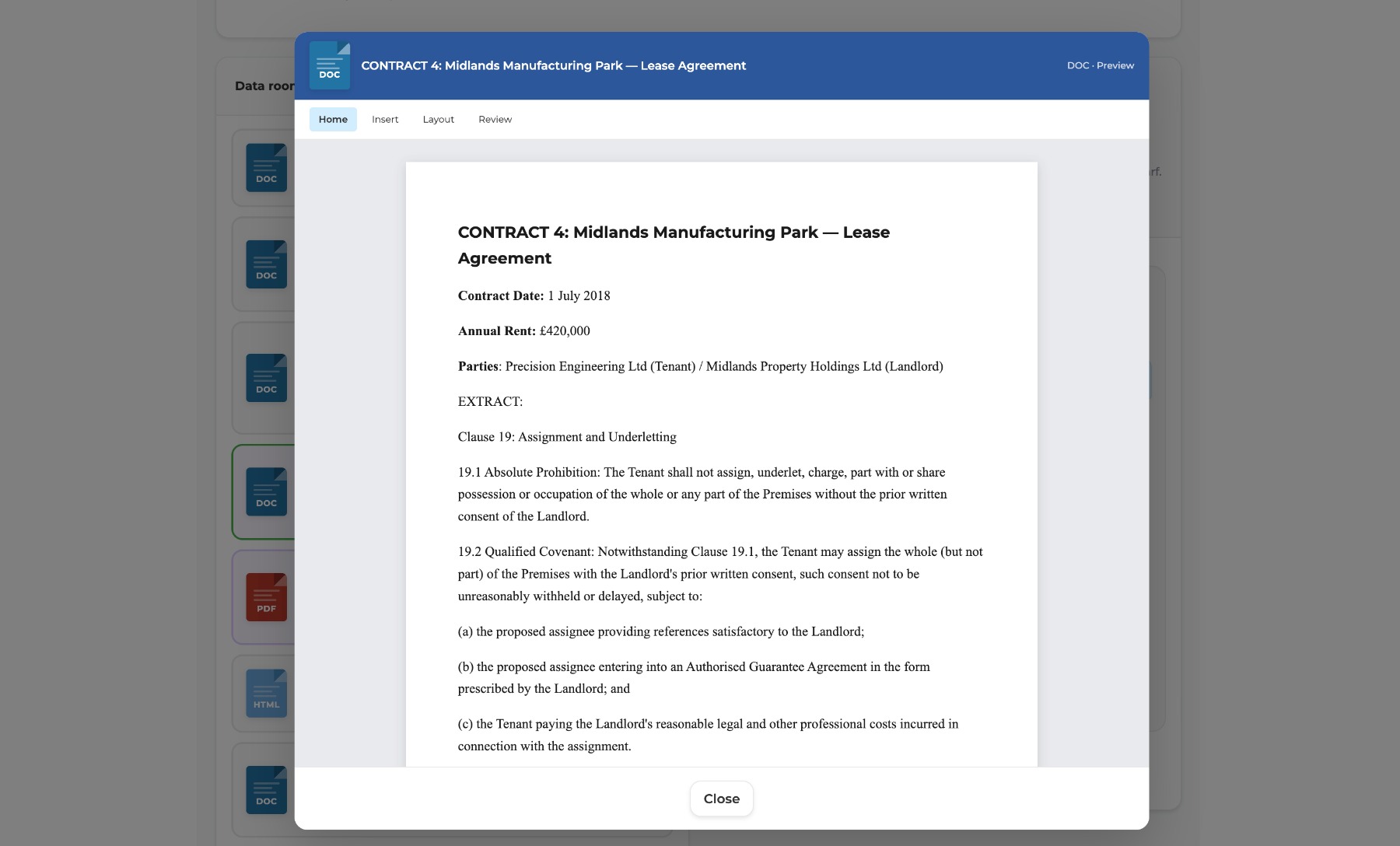
This second stage trains something different from the first.
- Stage one is about breadth — scanning across a set of documents with a clear question in mind.
- Stage two is about depth — reading one document carefully enough to find what is wrong with it.
Both skills matter; few training programmes build both within the same exercise.
What makes this reusable
- The format is content-agnostic. The same two-stage structure works for a trainee reviewing warranty disclosures, an apprentice checking a lease for break clause compliance, or a law student working through a set of loan agreements in a restructuring scenario. The documents change. The underlying exercise does not.
- Because the documents are extracts rather than full contracts, they can be generated or assembled without reproducing confidential materials. A fabricated extract that reads like a fabricated extract defeats the purpose — the language needs to be real enough that the student cannot skim it. But two focused pages of genuine drafting, with the surrounding boilerplate stripped away, is often more instructive than the full document.
- The other advantage of extracts is pace. A student reading twelve full contracts loses the thread of the exercise. A student reading twelve focused two-page extracts develops the triage instinct the exercise is designed to build — and finishes with energy left for the discussion that follows.
- Such simulations are generated, not created manually. That makes implementation of these projects fast and friction-free.