Report: Integrating Simulations into Law Firm Learning and Development

The legal industry faces pressing challenges in training and skill development, traditionally relying on methods like lectures, workshops, and webinars. While adequate, these methods are time-consuming, costly, and often fail to provide measurable ROI or high retention rates. In a rapidly evolving landscape marked by technological advancements, simulation technology emerges as a game-changing solution. It offers a myriad of applications ranging from recruitment and onboarding to ongoing internal training and specialized programs. Moreover, simulation technology allows for real-time analytics that can fundamentally redefine KPIs in learning and development (L&D).
Traditional Training Limitations: The old models are time-intensive and costly, with low engagement and retention rates. The industry spends about $9.1 billion annually due to turnover, partly stemming from ineffective training.
The Need for Modern L&D: Given the complexity and competitiveness of the legal industry, a robust L&D strategy is essential for talent retention, skill enhancement, and maintaining a competitive edge.
Simulation Technology Advantages:
Applications of Simulation:
The legal industry is a complex and dynamic field that requires continual learning and skill development. For years, law firms have relied on traditional training methods such as workshops, seminars, and webinars to keep their teams up-to-date with the latest legal frameworks, technologies, and client management strategies. While these traditional approaches have served firms adequately, there are inherent challenges. They often consume significant amounts of time and resources, and their impact on skill retention and real-world applicability may be limited.
In an era characterized by rapid technological advancements and rising client expectations, there's an increasing need for innovative solutions to modernize the learning and development (L&D) landscape in law firms. The most evident solution is the combination of the tools that have proven their efficiency over the decades (one-to-one mentorship, hands-on practice) with the tools that have become available just now: interactive web-based learning, natural language processing (NLP), and generative AI.
In any competitive industry, the value of L&D cannot be overstated, and law is no exception. An effective L&D strategy serves multiple crucial functions within a law firm:
According to JD Match and Right Profile, the top 400 law firms lose about $9.1 billion annually due to turnover—with an approximate cost to a firm of $400k to $800k each time an associate leaves the firm.
Traditional methods of training within law firms, such as lectures, workshops, and online courses, often face a number of limitations:
Time-Consuming
The average attorney spends approximately 15 hours per year on CLE, 30 hours of in-house training, and hundreds of hours on watching videos and researching new topics. This often takes time away from billable hours and client work.
Limited Retention
Studies show that learners retain just 10-20% of information obtained from traditional lectures. This begs the question: How effective is this mode of learning for the practical application of skills?
Costs and ROI
The average law firm spends about $1,200 per employee per year on training, with some top-tier firms spending up to $5,000. Yet, the returns on this investment, in terms of skills development and retention, often remain unclear.
Legal firms will typically purchase online video training programs for their associates. This can be an inexpensive route to take, with a cost per associate of approximately $500-$1k. But again the ROI of such training is next to impossible to count. 50% of companies felt it was difficult to measure their training ROI. That's why an overwhelming 61% of training leaders said that they don’t measure training ROI.link
Limited Engagement
Survey data indicates that only about 40% of trainees find traditional training programs to be engaging, limiting the effectiveness of the training.
Simulation training may sound just like another fancy technology until we see how it can help law firms solve the inherent problems connected with training.
Data-driven training
Simulation training may provide extensive data on how the students are developing their skills. This data can be used to assess the efficiency of existing training programs and the readiness of the lawyers for real-life projects.
This gives the L&D team transparent indicators and tools to make their next decisions.
Cost-Effectiveness
Simulation training is characterized by long-term usability, scalability, and the reduced need for external trainers. Simulations can reduce the time needed for training by up to 50%, allowing lawyers to quickly apply learned skills in their day-to-day work.
Mistake-friendly environment
Reports say that students say that they prefer simulators to other types of training because simulators create a mistake-friendly environment.link
Engagement
Studies show that up to 80% of learners claim they would be more productive if their work was more game-like, which is an essential aspect of many training simulations. And AI technologies available now to any company have brought interactivity to a new level.
Measurable Impact
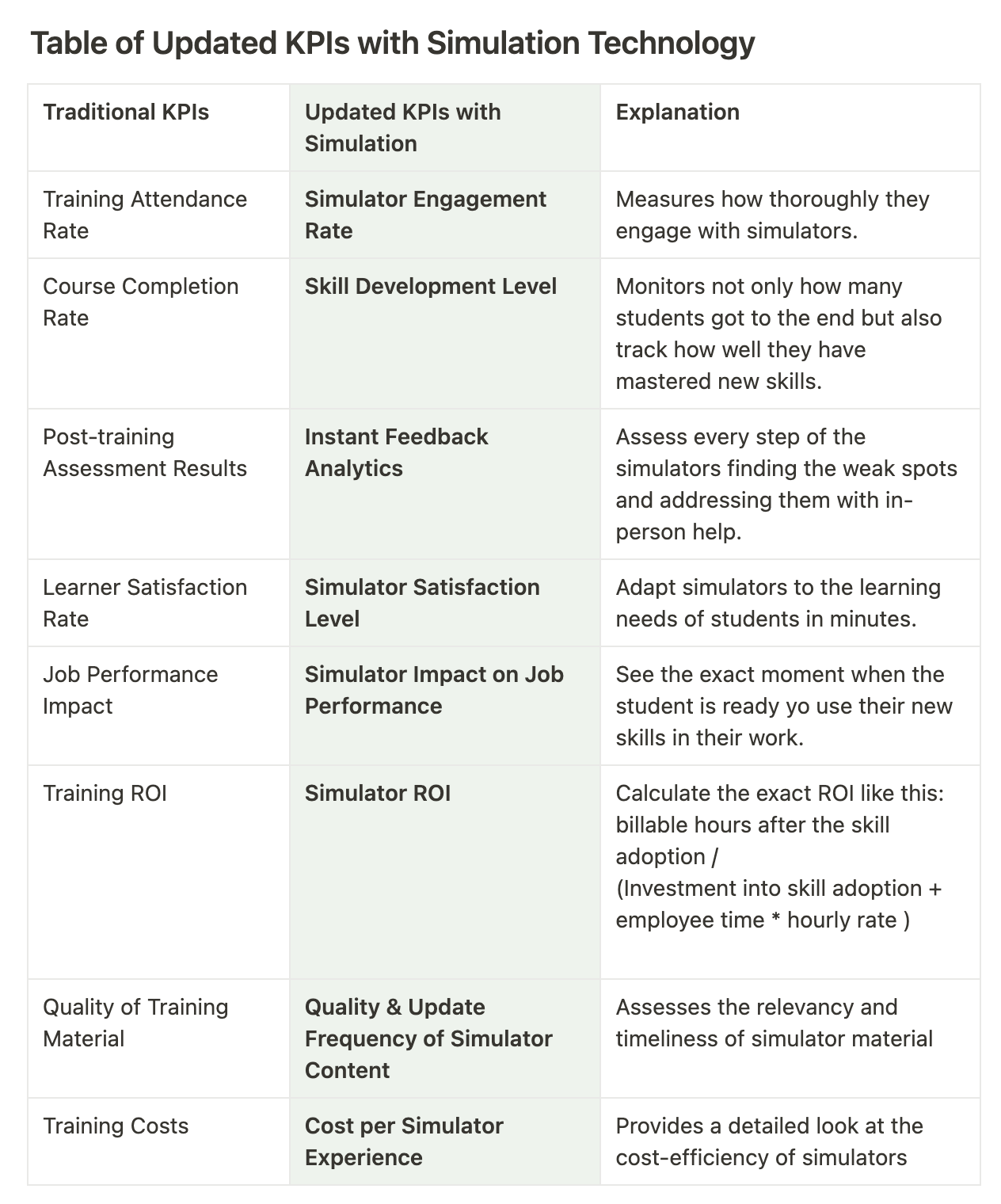
Simulations offer real-time analytics and reporting tools, allowing for measurable KPIs such as training attendance rate, course completion rate, post-training assessments, and more. This provides clear data on the ROI of the training program.

Simulation technology offers a transformative approach to learning and development. Traditional training methods like lectures and webinars are often static, one-way forms of communication. In contrast, simulators like those for drafting, compliance, and due diligence create a dynamic, two-way interaction. They allow lawyers to develop practical skills in a risk-free environment, complete with instant feedback on their performance.
Applications of Simulation Technology
Simulation technology is versatile, and able to address a range of needs within the legal education and training landscape. Here are some primary applications where it can make a significant impact:
And all these processes will now rely on real-time data gathered from every step the student makes on a simulator.
In summary, simulation technology provides an array of applications that can fundamentally revolutionize the way law firms approach recruitment, onboarding, internal training, mentorship, and ongoing assessment. Its versatility, adaptability, and data-driven nature make it an essential tool for any forward-thinking law firm.
Common Concerns
Key Takeaways
Simulation technology offers a transformative approach to learning and development in law firms. With real-world scenarios and instant feedback, they bridge the gap between theoretical knowledge and practical application. This not only enhances skill development but also provides a measurable impact on job performance. Coupled with the ability to update key KPIs to reflect this new mode of training, law firms are well-positioned to optimize their learning and development initiatives for the future.
In sum, as the legal industry becomes more competitive and the skills required for success become more complex, the case for integrating simulation technology into law firm training programs is not just compelling—it's imperative.